Carpenter Ant Identification

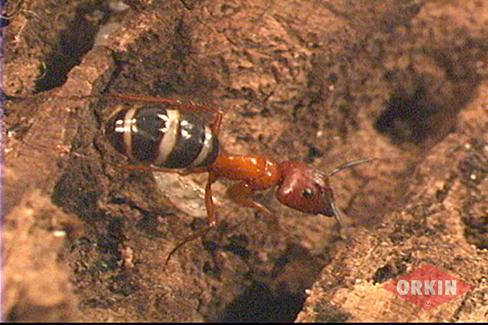
Carpenter ants are common sights in the Americas, Europe and other parts of the world. Because carpenter ants cause damage to wooden areas where they nest, their presence can be mistaken for a termite infestation. However, while termites eat wood, carpenter ants merely make galleries in wooden areas for shelter.
All species of carpenter ants prefer decayed wood for their nesting sites, as these areas provide proper and consistent humidity and temperatures. Although carpenter ants do not eat wood, damage can be severe when nests remain active for several years. Over time, a colony can expand into several satellite colonies near the parent colony. Workers excavate wood for extra space, causing extensive damage to structures and woodwork.
There are 24 pest species of carpenter ants in the United States alone. For this reason, carpenter ant identification can be difficult. Size and color of carpenter ants can vary among species and even among individuals within one colony. Carpenter ants measure from 3.4 to 13 mm in length and can feature black, red, brown, yellow, orange, or red and black coloration. Although carpenter ants are among the largest ant species worldwide, size is not a reliable factor in carpenter ant identification because workers within a species vary in size.
Carpenter ants are often mistaken for termite swarmers, particularly during swarms when winged male and female ants fly out of their colony to mate. The most important characteristics to look for when identifying any winged ant are elbowed antennae, a pinched or constricted waist and a front pair of wings that is longer than the back pair. Termite swarmers will have straight antennae, a broad waist and both pair of wings similar in length.
Carpenter ants develop by complete metamorphosis: from eggs to larvae to pupae to adults. Adult carpenter ants have six legs, a constricted waist, three distinct body regions and a ring of hairs at the tip of the abdomen (best seen under magnification.)
Locating carpenter ant nests can be accomplished by following the trails of the worker ants themselves. Search for a clean and smooth cavity in the infested area, as well as slit-like windows in the surface of the damaged wood. Small piles of wood shavings can often be found below the openings. After identifying a colony, it is advisable to contact a pest control professional, as several satellite colonies may exist elsewhere within or around the home or building.

