What Does a Carpenter Ant Look Like

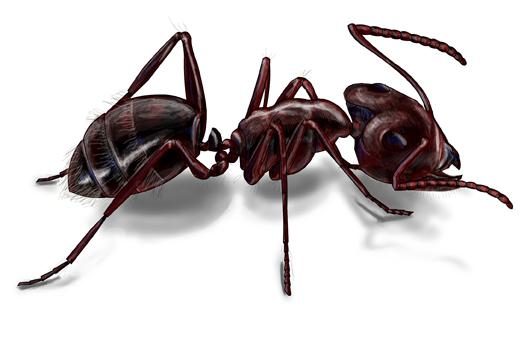
Carpenter Ant
Carpenter ants belong to the genus Camponotus and are "polymorphic." This means that there are workers of varying sizes in the colony. There is usually only one wingless queen. Winged male and female carpenter ants appear after the colony is mature—usually after two years. Carpenter ant workers have black, dark brown, red and black, yellow or red coloration with sizes ranging from 3.4 to 13 mm. Black carpenter ants have uniform dark brown and black colors, while red and black carpenter ants have dark brown and black bodies with a red-brown thorax.
Several species of carpenter ants exist within the United States, so size and color are not always reliable identifying characteristics. Carpenter ants are distinguished from other species by the rounded profile of their thorax, the heart-shaped head and circle of hairs around the anus. (These identifying characteristics are best seen under magnification.)
Queen carpenter ants and reproductive males have forewings that are larger than their hind wings. These wings are transparent or light brown. The winged carpenter ants appear in the spring or fall. After the females are fertilized, they make a nest to start a colony.

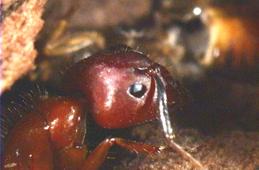
Carpenter Ant Working Close Up
The eggs of carpenter ants are oval-shaped and cream colored. Carpenter ant larvae are legless. During the pupal stage, they transform into adult ants.