Caddisfly Facts & Information
Protect your home or business from caddisflies by learning techniques for identification and control.
Treatment
How do I get rid of caddisflies?
What You Can Do
The best approach to treating caddisflies is to be patient since they do not live more than a few days after becoming flying adults. If putting up with the swarm is not possible, using a heavy-duty vacuum or applying registered and appropriately labeled chemical insecticide will help reduce the problem by quickly knocking down the population.
Non-chemical approaches to treatment involve light management. Some successful practices include:
-
Monitor: Turning lights off when adult caddisflies are flying.
-
Relocate: Installing lights away from buildings, if possible.
-
Replace: Replacing standard incandescent and fluorescent lights with sodium vapor lights that are less attractive to insects.
Frequently Asked Questions
Behavior, Diet & Habits
Understanding Caddisflies
General Information
Caddisfly is a generic name given to the insects that belong to the order Trichoptera. There are approximately 1,200 U.S. species within this order, and some entomologists study caddisflies exclusively. The caddisfly is known by many names, including sedge, shadfly, and periwinkle.
Appearance
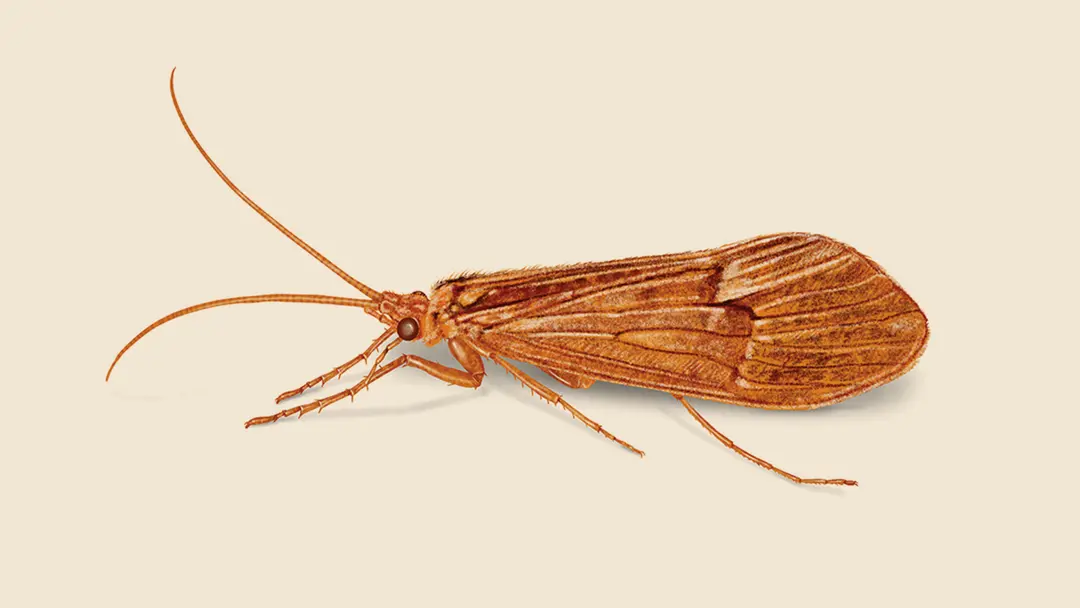
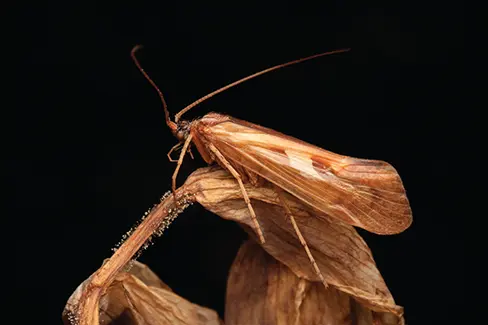
Adult caddisflies are similar in appearance to moths, and while the name might suggest otherwise they are not flies (flies belong to the order Diptera). Caddisflies have minimized mouthparts and well-developed compound eyes.
Habitat
Adult caddisflies are terrestrial, while larvae are aquatic and can be found in lakes, rivers, streams and other freshwater sources. Although they live on land, adult caddisflies typically inhabit areas near freshwater sources in order to ease breeding processes. These insects form a very significant part of freshwater food chains, and their presence typically indicates that an aquatic ecosystem is healthy.
Diet
They help keep these bodies of water clean by feeding on fallen leaves and other detritus, while also acting as a source of food for predators.
Predators
Caddisflies serve as a possible food source for a whole host of animals including:
Pupal Stage Shells/Casings
Caddisflies make shells or casings for their pupal stage. The type of materials used for caddisfly casings varies from species to species. Some use soil for casings, while other caddisflies use dead twigs and leaves.
Flies vs. Caddisflies
Flies from the Diptera order have only one pair of wings, while caddisflies have two pair of wings. Many flies lay their eggs in decaying or fermenting material. When fly eggs hatch, the larvae eat the decaying material where they hatch.
However, caddisfly larvae feed on detritus material from the bottom of lakes or rivers. This is because caddisflies lay their eggs on the surface of bodies of water.
Reproduction & Life Cycle
Like many other insects, the complete life cycle of the caddisfly is comprised of four stages: egg, larval, pupal and adult. After mating, the female caddisfly skims the surface of a water source and deposits her eggs in strand-like formations. These eggs are a bright green in color and sink to the bottom.
Eggs eventually hatch into caddisfly larvae. Caddisfly larvae are grub-like in appearance and feed on detritus within the bodies of water they inhabit. Caddisfly larvae create strands of silk from their salivary glands. After feeding, caddisfly larvae begin to form casings used in the pupal stage. These cases are constructed of small rocks, twigs and other gathered materials.