Flour Beetle Facts & Information
Protect your home or business from flour beetles by learning techniques for identification and control.

Treatment
How do I get rid of flour beetles?
What Orkin Does
Controlling flour beetles starts with a thorough inspection. Every infested package should be thrown away. Vacuum the pantry and cabinet shelves. This will remove food particles. Store new food products in sealed containers to prevent new infestations.
Insecticide application is the last step. The insecticide should go into cracks and crevices. The object is to eliminate any flour beetles that may be hiding.
Due to the difficult nature of these pests, it is advisable to contact your local Orkin branch office.
Frequently Asked Questions
Behavior, Diet & Habits
Understanding Flour Beetles
Appearance
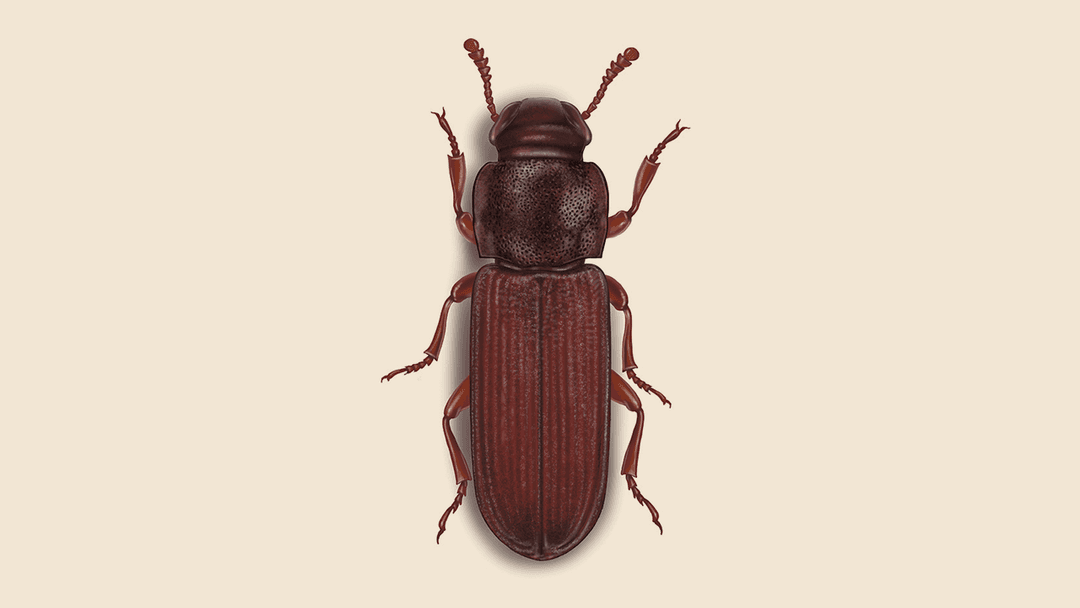
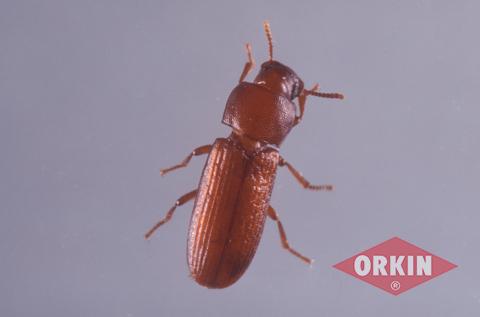
Two of the most common flour beetles are the confused flour beetle, Tribolium confusum (duVal), and the red flour beetle, Tribolium castaneum (Herbst). These are small beetles.
-
Size: The adults are about 3 to 4 mm long.
-
Color: They are reddish brown in color.

Flour Beetle
There are differences between the antennae of these two beetles. Since these insects are so small, it usually requires a magnifying glass to recognize these differences.
Diet
Flour beetles are pests of flour and cereal products. They are among the most important pests of flour and stored products.
Habitat
They are common in homes and grocery stores. They also infest mills and food processing facilities.
The flour beetles include several species. Some of the other flour beetles are the black flour beetle, the false black flour beetle, the broadhorned flour beetle, the slenderhorned flour beetle, the depressed flour beetle, the smalleyed flour beetle and the longheaded flour beetle. These do not occur as often as the red and the confused flour beetles.
The red flour beetle originally came from Asia. In the United States it is most common in the South. The red flour beetle is a good flier. It sometimes flies from fields into buildings.
Red Flour Beetle vs. Confused Flour Beetle
Some people suspect that the confused flour beetle got its name from being confused with the red flour beetle. The confused flour beetle originally came from Africa. In the United States it is one of the most important pests of home pantries and grocery stores. Although it has wings, it typically doesn't fly.
Reproduction & Life Cycle
Flour beetles do not attack whole grains. The female beetle deposits eggs directly on flour, cereal, dry pet food or other similar products. The females deposit a few eggs each day in the food that she is eating. The egg laying can last several months. The eggs are hard to see in flour or meal.
The larvae hatch and begin to eat the material where they hatched. The larvae are 4 to 5 mm long. Flour beetles can develop from egg to adult in as little as seven weeks. In warm environments, there can be four or five generations per year.