How to Tell Earwigs and Termites Apart
Biologists have created a system of scientific taxonomy to classify all living beings. This is explained in detail under “What Are the Differences Between Earwigs and Cockroaches?” As a result of taxonomy, it is clear that earwigs are in a different order than termites. Earwigs are in the order Dermaptera, and termites are in the order Isoptera. Dermaptera means “skin wings” due to the leathery durable forewings. Isoptera means “equal wings,” a hint that termites, for the castes which are winged, have wings of the same size. Even though not all termites are winged, reproductive termites, or alates, are winged. While there are non subterranean termites, for this discussion we’ll focus on subterranean termites, the most common type of termite in the U.S.
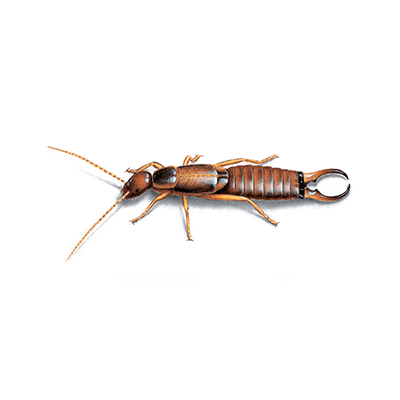
While earwigs and termites each have six legs and three body segments, as do all insects, there are many differences. First, termites are social insects, meaning that they have a hierarchy including king, queen, workers and soldiers. Earwigs do not exist in a social structure, and, while there may be many earwigs in an area, say, under mulch, they are not in a “colony” or truly social. Also, earwigs are simply male or female and have no castes such as worker or soldier. Also, termites need moisture as do earwigs, but most earwigs survive well in the open. Termites, especially subterranean termites, are cryptic and cannot come into open sunlight or air for long, since their bodies are soft and desiccate rapidly. Worker termites are usually white since the chitin in their shells has not hardened; earwigs are darker with hardened chitin.
Food choices for earwigs include live or decaying vegetation and, in some cases, depending on the species, other insects. Termites do not eat other insects and eat only cellulose products such as wood.