Black Widow Spider Facts & Information
Protect your home or business from black widow spiders by learning techniques for identification and control.
Black Widow Spider Treatment
How do I get rid of black widow spiders?
How Orkin Can Help Get Rid Of Black Widow Spiders
Orkin Pros are trained to help manage spiders and other pests. Since every yard or home is different, the Orkin Pro will design a unique spider treatment program for your situation.
Keeping spiders out of your home is an ongoing process, not a one-time treatment. Orkin’s exclusive A.I.M. solution is a continuing cycle of three critical steps — Assess, Implement and Monitor.
Orkin can provide the right solution to keep spiders in their place...out of your home.
Frequently Asked Questions
Behavior, Diet & Habits
Understanding Black Widow Spiders
What do black widow spiders look like?
-
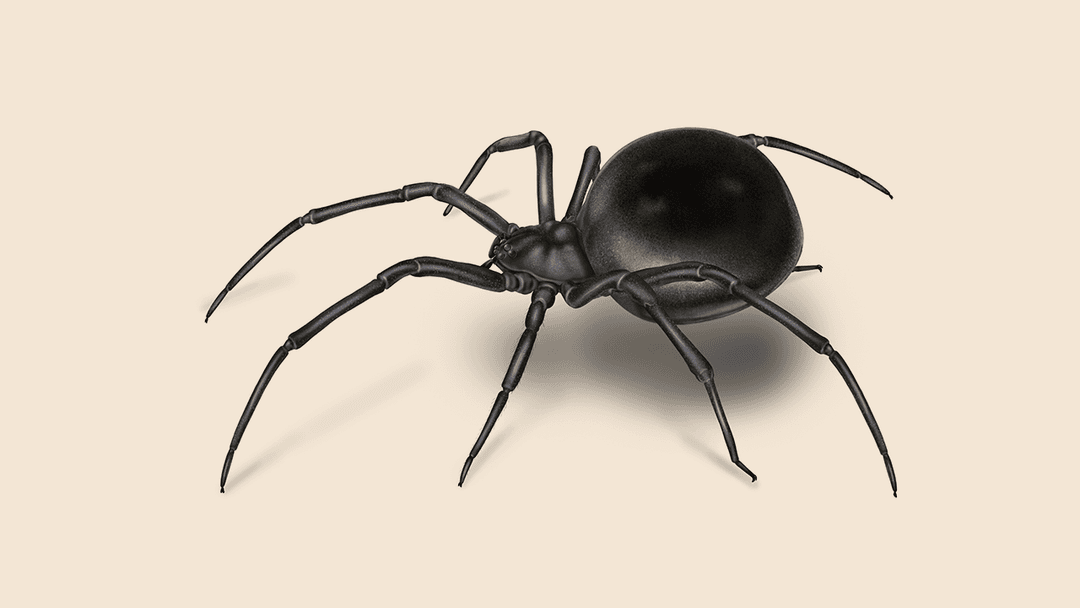
Hourglass marking: Black widows are identified by red hourglass markings on the underside of their abdomens. This marking is bright red and signals danger to predators and attackers.
-
Color: Black widows are shiny black in color.
-
Size: Most black widow spiders' bodies are 3 to 10 mm in size. Females are larger than males and can measure 13 mm in body length.
What do black widow spiders eat?
Black widow spiders are opportunistic predators, feeding primarily on insects like ants, caterpillars, and cockroaches. They paralyze their prey with venom and digest it externally by liquefying the tissues. Though they mainly eat insects, they may occasionally capture small animals like frogs or lizards.
Where do black widow spiders live?
Several species of Latrodectus or “widow” spiders are present in North America. They thrive primarily in temperate zones and are known to be abundant in the American South. The most common species are the southern widow (Latrodectus mactans) found in the American South and Northeast; Latrodectus hesperus found in the west; the brown widow (Latrodectus geometricus) found in the South; and the northern widow (Latrodectus variolus) found in the Northeast.
Where do black widow spiders hide?
Black widow spiders favor dark, secluded areas such as crevices and woodpiles. Inside the home, black widows typically hide in sheltered, dimly lit locations such as garages, dark corners, basements, closets, and cluttered areas.
Black Widow Spider Bite
Female black widow spiders are capable of biting, and their bites can pose a significant danger. These spiders usually bite only when they feel threatened, such as when their webs are disturbed. The bite might feel like a slight pinprick at first but can lead to severe symptoms within hours, including intense pain, muscle cramps, nausea, and difficulty breathing. Although fatalities are rare with prompt medical care, the spider's neurotoxic venom can cause significant discomfort and complications. If you are bitten, seek medical attention, especially if you experience severe symptoms.
Black Widow Characteristics
-
Comb foot: An important characteristic of the black widow spider is its comb foot. This row of strong, curved bristles is located upon the hind pair of legs and is used to pitch silk over captured prey.
-
Shy: Black widows are shy in nature. They are solitary, socializing only during copulation.
-
Nocturnal: Black widows are nocturnal and spin webs during the daytime.
-
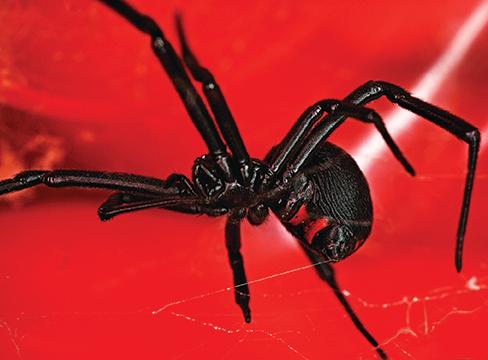
Hang upside down: They can sometimes be seen hanging upside down in their web, exposing a telltale hourglass abdominal marking.
Male vs. Female Black Widow Spider
On average, male black widow spiders are smaller than females, reaching only about half their size in length. However, the legs of the male black widow are considerably longer in proportion to the female’s and are marked by orange and brown at the joints. Males may exhibit red and white stripes on the abdomen depending on the species and are more colorful and finely patterned than females.
Black Widow Webs
Black widows spin a large web where the female suspends a cocoon that can contain hundreds of eggs. These spiders also use their webs to capture their prey, which includes insects such as flies, grasshoppers, beetles, etc. Read more about the black widow's web.
Black Widow Spider Web Closeup
Types of Black Widow Spiders
Northern Black Widow
As designated by its name, the northern black widow spider (Latrodectus various) is found primarily in the Northeast United States. They may live as far south as Florida, as far north as Canada, and as far west as Texas.
Species of widow spiders are also occasionally transported in shipments of household goods to states outside of their natural range. Northern black widows are primarily found in marginal land habitats with sparse vegetation, stumps, hollow logs, and piles of debris. Northern black widow spiders are rarely found indoors. However, they may enter human dwellings on piles of firewood or other items brought inside. Most adult female northern black widow spiders are shiny black, with rows of red spots atop the abdomen. Crosswise bars that resemble a red hourglass appear on the underside of the abdomen.
Southern Black Widow
The weather in the American South is extremely conducive to the development of black widow spiders, and several species can be found. A great example is the southern black widow spider (Latrodectus mactans). They are one of the most common black widow species in the Southern United States. Females spin irregular and nonsymmetrical webs. They do not prefer to venture indoors but can be found in garages or basements near openings to the outdoors such as around garage doors.
Like the northern black widow, the female southern black widow spider is jet-black in color and shiny. They also have a red hourglass-shaped mark on the underside which serves to identify it.
How the Black Widow Spider Received Its Name
The black widow spider received its name due to a story about its mating behaviors. Courtship begins when males go out in search of receptive females. Upon approaching a web-spinning female, the male spider will wait for an indication of her willingness: females interested in mating remain still, allowing males to inseminate them.
As the story goes, following insemination, female black widow spiders kill and feed upon their mates. This story led to the black widow's name. However, it is a misconception that all female black widows kill and consume their mates. Rather, this behavior is typically only observed in captivity.
The black widow contributes to the balance of the ecosystem by consuming insects such as flies and mosquitoes. It also controls crop pest populations, feeding on pests that defoliate plants, including locusts, grasshoppers, beetles, and caterpillars.