Thrip Facts & Information
Protect your home or business from thrips by learning techniques for identification and control.
Treatment
How do I get rid of thrips?
What Orkin Does
Sometimes chemical treatments for thrips are necessary when populations in lawns, grassy areas or on ornamental and landscaping plants are large. However, most of the time thrip treatments can be accomplished using non-chemical techniques.
Some examples of non-chemical treatments your pest management professional may employ or recommend include removing infested plants, excluding thrips from getting inside the structure and using vacuums to physically remove dead or living insects.
Frequently Asked Questions
Behavior, Diet & Habits
Understanding Thrips
Appearance
-
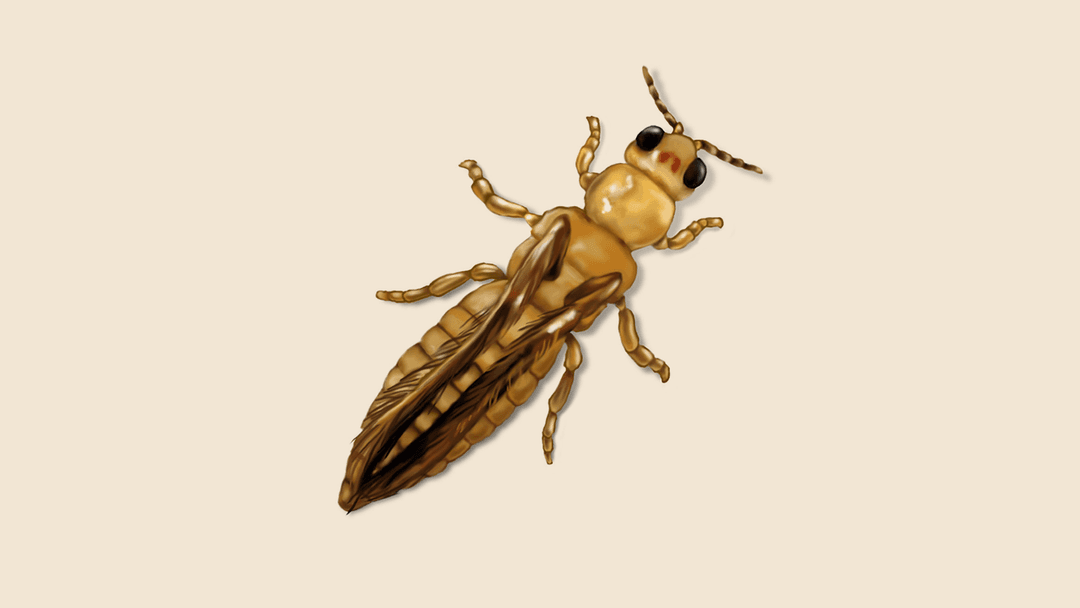
Size: Thrips vary in size, though most measure between 0.5 to 5 mm in length. Thrips are small insects and may or may not have wings.
-
Wings: Winged thrips have fringed wings; in fact, the name of the order Thysanoptera is derived from the Greek words for fringe (thysano) and wing (ptera). More than 5,000 species of thrips have been identified.
-
Mouthparts: Thrips possess distinctive asymmetrical mouthparts with one mandible longer than the other. Some thrips use their mouthparts to puncture the outer layer of plants, from which they extract sap, while others use them to puncture the skin of animals such as other insects, from which they extract body fluids.
Crop or Plant Damage
Plant-feeding thrips are capable of damaging crops. After feeding on plants, thrips leave visible signs of damage such as deformities and blackening of the skin. Thrips may also lay their eggs on fruits and crops, resulting in small discolorations surrounded by white haloes. In addition to marring the appearance of flowers, these thrips can spread a number of plant diseases, such as the tomato spotted wilt virus and the necrotic spot virus.
Because their feeding habits destroy a number of commercial crops, thrips are considered especially problematic in agricultural communities. They are known to proliferate quickly and swarm heavily in areas with crops.
Thrips do invade homes, possibly brought in on potted plants, and some species have been known to bite humans. If thrips populations are not controlled, affected flowering plants may lose their ability to produce.
Reproduction & Life Cycle
Leaf-feeding and flower thrips deposit eggs into plants through an egg-laying apparatus called an ovipositor. Their eggs are identifiable by the halolike spots they leave on leaves and fruits. Their pupae cause further discoloration.
Thrips have a metamorphosis unlike most other insects. Technically, they have gradual metamorphosis but it has aspects similar to complete metamorphosis. Thrips emerge from eggs and develop through two wingless stages. But then they have a nonfeeding stage called the prepupa before developing into pupae. Thrips typically develop into mature adults within 20 days.
Upon emerging from their cocoons, young thrips feed on the plants on which they were initially deposited. While young stages are similar in appearance to their adult counterparts, they do not have wings and move from plant to plant by crawling until their wings develop.
Nymphs hatch and undergo a series of molts until they become adults. Prior to becoming adults, late-stage nymphs cease feeding and a find a protected location to molt.
Types of Thrips
-
Common plant-feeding thrips are flower thrips. These thrips are yellow, orange or amber in color. Flower thrips typically grow in population during spring.
-
Red-banded thrips (Selenothrips rubrocinctus) were first formally recorded in Guadalupe, West Indies, after causing significant damage to local cacao farms. Today, red-banded thrips are common in tropical areas around the world, including in the United States.
-
Like other thrips species, six-spotted thrips (
Scolothrips sexmaculatus) are slender and measure less than 3 mm in length. The
Scolothrips sexmaculatus have six spots upon their wings. They are capable of greatly reducing populations of these pests, particularly in corn fields, and are considered by farmers to be beneficial for crop protection and growth.
-
Of the 5,000 species of thrips, several feed on or infest banana fruits. Among these species, the most common are banana rust thrips (Chaetanaphothrips signipennis). Other species that cause harm to the banana plant include banded greenhouse thrips (Hercinothirps femoralis), banana rind thrips (Elixothrips brevisetis), and Hawaiian flower thrips (Thrips hawaiiensis).
-
South African citrus thrips are yellow-orange in color. Like other thrips species, they are extremely small, measuring approximately 1 mm in length. They are most active during hot and dry seasons and prefer soft leaves and young or immature fruits. In this previously unaffected area, these thrips were found feeding on the succulent Crassulaceae, which was never before victim to thrips infestations.
The word thrips is always spelled with a “s” since the word is both singular and plural just like the word species is both singular and plural.