Difference Between Deer Ticks and Wood Ticks
Deer ticks and wood ticks are broadly descriptive common names that are often used to refer to four species of ticks. Deer ticks usually refer to the blacklegged tick (Ixodes scapularis) and the western blacklegged tick (Ixodes pacificus), while wood tick refers to the American dog tick (Dermacentor variabilis) and the Rocky Mountain wood tick (Dermacentor andersoni). The common name deer tick is somewhat antiquated, but is still a frequently used name that is now correctly referred to as blacklegged tick.
Wood Ticks
Both species of wood ticks are members of the family Ixodidae, the hard ticks. They are dark brown in color with silver-gray or whitish coloring on their back. Both have a dorsal plate on their back called the scutum, and their mouthparts are visible when viewed from above the tick. The males are slightly smaller than the females in the adult stage. Both species have six legs in the larval stage; eight legs in the nymphal and adult stages; and undergo a life cycle that consists of four stages: eggs, larvae, nymphs and adults.
Neither of these ticks is considered a vector of Lyme disease, but they do transmit other diseases and both species are known to cause tick paralysis, a condition triggered by a toxin that is released from the tick’s salivary glands when taking a blood meal.
The American dog tick is the primary tick vector of Rocky Mountain spotted fever in the eastern United States and can also transmit tularemia. Overwintering American dog tick larvae are of special interest because they can acquire the disease organism that causes Rocky Mountain spotted fever by hatching from an infected egg and are infected with the disease without feeding on an infected host. This phenomenon is known as transovarial transmission. The Rocky Mountain wood tick can transmit Colorado tick fever, tularemia and Rocky Mountain spotted fever to humans.
Deer Ticks
Deer ticks are also in the family Ixodidae. Blacklegged ticks (Ixodes scapularis) and the Western blacklegged ticks (Ixodes pacificus) are also known as deer ticks and are often mistaken for brown dog ticks. Named for their propensity to feed on white-tailed deer and other Western deer species, these ticks may also feed on other small and large mammals as hosts, including humans. Livestock and domestic animals can also be hosts. Ixodes scapularis is primarily found in the eastern half of the United States and Ixodes pacificus is primarily found in the western states of California, Oregon, Washington and eastward into Nevada, Utah and Idaho.
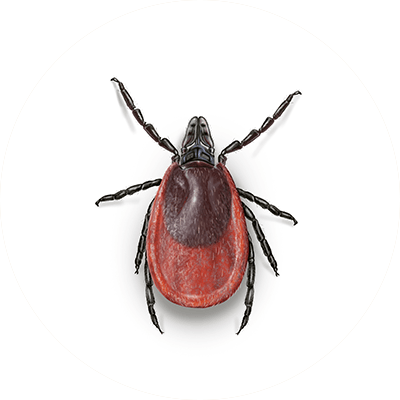
Deer ticks can sometimes be confused with other tick species, but generally are smaller than most ticks. Unfed adult female blacklegged ticks are approximately 3 - 5 millimeters (mm) long, are colored red and brown with a darker scutum shield on their back. Female ticks that are engorged with a blood meal appear darker and are about 10 mm long. The uniformly brown adult male tick is smaller than its female counterpart. Nymphs are between 1-2 mm long (about pin-head sized) with eight legs and larvae are less than 1 mm long (about poppy seed sized) and have only six legs. Deer tick adults are about half as large as the wood ticks.
Deer ticks are the most common vectors of Lyme disease. Their preferred habitat is shaded grassy and brushy areas frequented by both small and large mammals, dogs, cats and other warm-blooded hosts. As these hosts brush against the grass, deer ticks cling to the coat of the animal and begin to feed. Because the ticks usually bite a different host for their subsequent blood meals, infected ticks are capable of spreading Lyme disease quickly throughout a population. The small size of the deer tick is also a factor in the prevalence of Lyme disease. Their bites are not painful, and most victims do not notice them until they have become engorged from prolonged feeding and may have transmitted the Lyme disease organism.
Unlike Ixodes scapularis, Ixodes pacificus nymphs do not climb onto low vegetation and wait for a passing host. Instead, they live within litter on the forest floor, climb onto logs and the lower portions of tree trunks up to a height of about 3 - 4 feet to await a passing host.