Deer Tick Facts & Information
Protect your home or business from deer ticks by learning techniques for identification and control.
Treatment
How do I get rid of deer ticks?
What You Can Do
Try these prevention techniques to help keep deer ticks away:
-
Keep lawns closely trimmed.
-
Remove ground debris found around the yard.
-
Remove trees that provide shade.
-
Check for ticks on clothing and skin after outdoor activities.
-
Wear long sleeve shirts and long pants.
-
Use tick repellents when recommended by your family doctor or other medical professional.
What Orkin Does
Your local Orkin Pro is trained to help manage deer ticks and similar pests. Since every building or home is different, your Orkin Pro will design a unique tick treatment program for your situation.
Orkin can provide the right solution to keep black legged ticks in their place...out of your home, or business.
Frequently Asked Questions
Behavior, Diet & Habits
Understanding Deer Ticks
Deer Tick Hosts
Deer ticks, primarily found in the eastern half of the United States, are also known as blacklegged ticks, while often mistaken for brown dog ticks. Named for their propensity to feed on white-tailed deer, deer ticks may also feed on other large mammals as hosts, including humans. Humans are considered accidental hosts and may contract Lyme disease from bites. Livestock and domestic animals can also be hosts.
What do deer ticks look like?
-
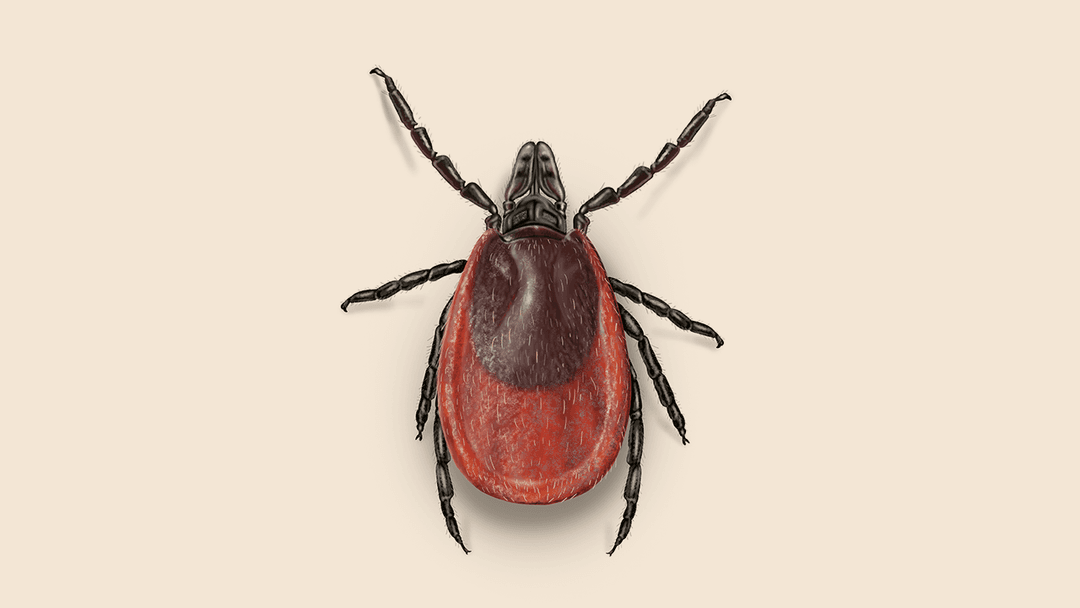
Adult Length & Color: These ticks are brownish in color but may change to rust or brown-red in hue following feeding. Adult males are smaller than females and are uniformly brown in color. Unfed adult female blacklegged ticks are approximately 3 - 5 mm long and are colored red and brown. Females that are engorged with a blood meal appear darker and are about 10 mm long. In most cases, a deer tick is usually half the size of the common American dog tick.
-
Adult Bodies & Legs: Like other ticks, their bodies are flattened, and after becoming engorged by a blood meal, the body expands substantially. They possess eight legs as adults.
-
Nymphs: Nymphs are between 1-2 mm long (about pin-head sized) with eight legs.
-
Larvae: larvae are less than 1 mm long (about poppy seed sized) and have only 6 legs.
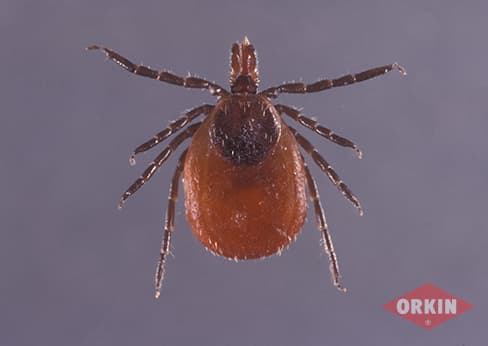
Female Deer (Black-legged) Tick
Where do deer ticks live?
Deer ticks are found in many locations where their preferred host, the white-tailed deer, dwell. They are present throughout the majority of the eastern United States and tend to live in wooded areas and along trails in forests.
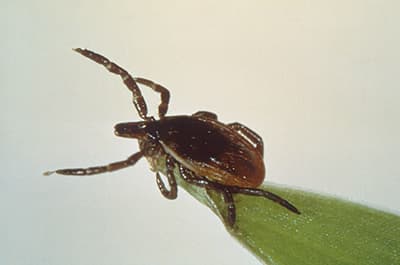
Deer ticks reside on the tips of grass and leaves along these trails, enabling them to crawl directly onto the skin or fur of a passing host. Some of these trails may be found in suburban areas where forests meet subdivisions. Deer and other animals are often active in these areas.
What do deer ticks eat?
All three of the deer tick's development stages require blood meals from hosts. They attach themselves to and feed on one host during the larval stage, another during the nymphal stage and a third during their adult stage. Larvae and nymphs both molt after feeding.
Life Cycle of a Deer Tick
Deer ticks take approximately two years to complete their life cycles. Development depends on environment and the availability of hosts. Under favorable conditions, they may be capable of developing in less than one year.
After laying eggs, female deer ticks die. However, one female is capable of laying up to 3,000 eggs. Six-legged larvae emerge from these eggs and begin to search for a host. Larvae feed for approximately four days before dropping to the ground to molt into nymphs. Resulting nymphs have eight legs and search again for hosts. They, too, will feed and molt into adults.
Deer Tick Eggs
Deer ticks begin life as eggs and develop through larval and nymphal stages before becoming adults. Females lay eggs in suitable areas close to vegetation.
Deer Tick Larvae
Larval and nymphal deer ticks prefer small hosts and are more likely to feed on rodents than on large animals. The larval feeding stage is responsible for the tick's contraction of most diseases like Lyme disease, while these diseases are transferred to humans and livestock during the nymphal and adult stages.
Lyme Disease Facts
Lyme disease is a debilitating disease caused by the bacterium Borrelia burgdorferi. Deer ticks are the most common vectors of this bacterium. Lyme disease is easily transmitted to human and animal hosts through deer tick bites.
Although deer ticks do not jump or fly, they remain in grassy areas frequented by dogs, cats, and other warm-blooded hosts. As these hosts brush against the grass, deer ticks cling to the coat of the animal and begin to feed. Because they potentially bite a different host for the next meal, infected ticks are capable of spreading Lyme disease quickly throughout a population.
The small size of the deer tick is also a factor in the prevalence of Lyme disease. Their bites are not painful, and most victims do not notice them until they have become engorged from prolonged feeding.
How to Remove Ticks
Due to the arachnid's small size, it can be difficult to locate the pest on its host. These parasites attach themselves to hosts and hide within the fur, hair, or feathers. Deer ticks should be carefully removed from their hosts. Improper removal may prove ineffective and can increase the risk of infection or of contracting a disease. Deer ticks are arachnids that use their mouthparts to penetrate the skin of their hosts. If mouthparts are not thoroughly removed, secondary bacterial infections can occur.
Removing Ticks on Humans
On humans, deer ticks are commonly found in the areas near the nape of the neck or along the lower scalp. Extreme care must be exercised when removing these pests from the skin of any host, as bodily fluids may be released if the tick is crushed or punctured, which increases the risk of disease transmission. The most efficient removal method includes the use of tweezers or forceps. It is important to remove the entire tick, including its embedded mouthparts. Position the tweezers as close to the skin as possible and use a steady, gentle motion to remove the tick. The use of alcohol or petroleum jelly should be avoided prior to removal, as these substances may cause the specimen to regurgitate its food and release more germs into the host's blood stream. For medical concerns, contact a medical professional.
More Information
Sometimes people may not notice a deer tick has bitten them until it falls off their skin. Symptoms of a deer tick bite range from redness and itchiness to shortness of breath and paralysis.
Difference Between Deer Ticks and Wood Ticks
Deer ticks are usually smaller than other types of ticks and are vectors of Lyme disease. Wood ticks, on the other hand, aren't vectors of Lyme disease but can transmit Rocky Mountain spotted fever.