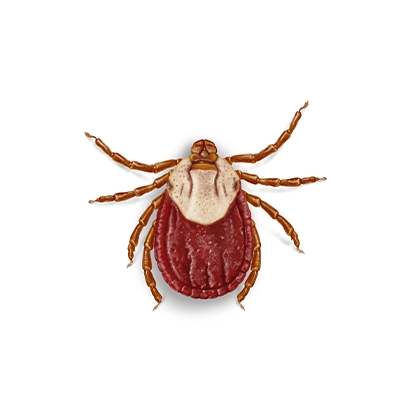
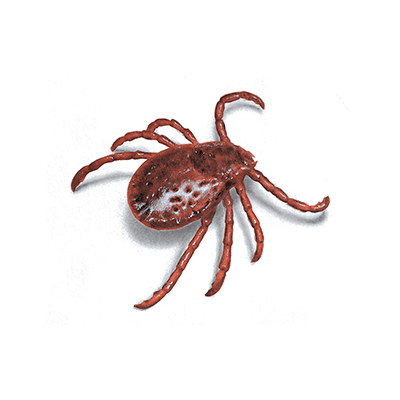
Tick Fevers & Diseases
A 2018 CDC statement revealed that illnesses spread by infected ticks have more than doubled since 2004. In addition, ticks have been found to carry seven new germs. While tickborne diseases vary by region, these areas are expanding. As a result, ticks now carry diseases to places that were previously unaffected by these pests.
Transmitted Through Blood Feeding
The disease organisms that cause tick-borne diseases are transmitted through blood feeding by tick larvae, nymphs and adults.
When a tick gets on a host and finds a feeding spot on its host, the tick grabs ahold and pierces its mouthparts into the host’s skin. Many tick species also discharge a cement-like substance that keeps them firmly attached during the blood feeding process. Ticks may secrete saliva that contains an anesthetic compound so the host can't feel that the tick has attached itself. Any pathogen a tick carries may be transmitted to a host during the blood-feeding process.
What Diseases Do Ticks Transmit?
Diseases known to be transmitted by ticks include:
-
Lyme disease
-
Rocky Mountain spotted fever
-
Colorado tick fever
-
babesiosis
-
tularemia
-
ehrlichiosis
-
southern tick-associated rash illness (STARI)
-
tick-borne relapsing fever
-
anaplasmosis
-
Powassan disease
-
rickettsiosis
-
heartland virus
-
64D richettsiosis
What Illnesses Do Ticks Transmit?
Some of the more common symptoms of tick-related illnesses are:
-
fever and chills
-
muscle aches
-
headache pains
-
plus rashes that are symptomatic of several diseases that produce distinctive rashes. Tick-borne diseases that often include rash symptoms include Lyme disease, southern tick associated rash illness (STARI), Rocky Mountain spotted fever, Colorado tick fever and ehrlichiosis.
Lyme disease
Lyme disease is the most common disease United States residents may contract from ticks. This disease is caused by a bacterium that is transmitted by the blacklegged tick in the northeastern and north-central United States and the western blacklegged tick, in the Pacific coastal states. Lyme disease is characterized by symptoms such as a circular rash surrounding the bitten area, joint pain, muscle pain, stiffness fever and general bodily pain. The rash associated with Lyme disease normally appears within 3-30 days before the onset of fever and is the first sign of infection. About 70-80 percent of persons who have contracted Lyme disease will develop this rash.
Rocky Mountain spotted fever
Rocky Mountain spotted fever (RMSF) is transmitted by the American dog tick, the Rocky Mountain wood tick and the brown dog tick. The primary distribution of Rocky Mountain spotted fever is the southeastern and Atlantic coast states, although this disease occurs in varying numbers throughout most of the United States. Typical symptoms include fever, headache, abdominal pain, vomiting and muscle pain. A rash may develop after a few days. In some cases, a rash does not appear at all. If not treated in the first few symptomatic days, Rocky Mountain spotted fever can lead to severe illness or even death.
Rocky Mountain spotted fever may often be misdiagnosed as the flu.
The rash seen with (RMSF) varies greatly in appearance, location on the body and time of onset. About 1 in 10 people with RMSF never develop a rash.In most cases, victims begin developing rashes two to five days after the onset of fevers. Though varying in appearance from case to case, rashes tend to look like small, faint-red spots on the wrists, forearms and ankles. Over time, rashes may spread to the trunk of the body. Sometimes the rash may show up on the palms and soles of the feet.
Ehrlichiosis
This disease is transmitted to humans by the lone star tick’s bite in the south-central and eastern states. The symptoms typically appear 1-2 weeks after being bitten by an infected tick. Since the tick’s bite is normally painless, most people who develop this disease may not even recall being bitten by a tick. Although symptoms may differ from one person to the next, the usual symptoms are fever, headache, chills, muscle pain, nausea, vomiting, diarrhea, redness of the eyes and a rash that shows up in about 30 – 60 percent of adults and children, respectively. Severe symptoms of those infected may include breathing difficulties and bleeding.
Babesiosis
Blacklegged ticks transmit babesiosis, which occurs primarily in the northeastern and upper-midwestern states, and the usual symptoms of the disease are flu-like and include fever, chills, sweats, headache, body aches and loss of appetite, nausea or fatigue. Babesiosis infects red blood cells and can cause anemia in some patients.
Tick-borne relapsing fever
Tick-borne relapsing fever is a bacterial infection with symptoms that include repeated episodes of fever, headache, muscle and joint aches and nausea. There are two types of relapsing fever – tick-borne and louse-borne. Common in the western United States, tick-borne relapsing fever is often associated with sleeping in mountain cabins that are infested with rodents. The average person seldom sees relapsing fever ticks because they are primarily "nest ticks" and prefer to feed on hosts that are in their nests or burrows. Infected soft ticks in the genus Ornithodoros and Carios transmit tick-borne relapsing fever.
Colorado tick fever
The disease organism that causes Colorado tick fever is a virus transmitted by the Rocky Mountain wood tick. This disease generally occurs in the Rocky Mountain States at elevations of 4,000 - 10,500 feet. Symptoms include fever, chills, body aches, fatigue, rash and headaches. Although rare, the virus can also be transmitted from person-to-person by blood transfusion.
Borrelia miyamotoi
This disease is transmitted by the blacklegged tick and has a distribution closely related to Lyme disease.
Tularemia
Tularemia is transmitted to humans by three tick species: the American dog tick, the Rocky Mountain wood tick and the lone star tick. Tularemia occurs throughout much of the United States and people can become infected by tick and deer fly bites, skin contact with infected animals, drinking contaminated water and by inhaling contaminated dust. Tularemia is reported to occur in every state except Hawaii.
Symptoms for Tularemia vary depending on how a person contracts tularemia bacteria. Tick-borne tularemia symptoms include high fever and skin ulcers at the site where the tick bite occurred. Also, ulcers are accompanied by swelling of the lymph glands, usually in the armpit or groin and sometimes a rash.
Anaplasmosis
This disease is primarily transmitted to humans by blacklegged tick bites in the northeastern and upper-Midwestern United States and by the western blacklegged tick along the Pacific coast. The typical symptoms include fever, headaches, chills, and muscle aches and sometimes cough and mental confusion. Usually, these symptoms occur within 1-2 weeks after a tick bite. Rashes may occur but are rare. Symptoms vary greatly from person to person and patients rarely have all of these symptoms.
Heartland virus
Heartland virus infection was identified in 2012 and has been identified in fewer than 10 patients throughout the United States, all of whom lived in Missouri and Tennessee. The lone star tick is the suspected vector of this disease. The symptoms of Heartland virus are headaches, muscle aches, diarrhea, loss of appetite and nausea.
364D Richettsiosis
This disease is found in California and other west coast areas where the Pacific Coast tick is found.
Powassan disease
The blacklegged tick and the groundhog tick transmit Powassan disease. Cases of the illness primarily occur in the northeastern states as well as the Great Lakes area. Signs and symptoms of infection can include fever, headache, vomiting, weakness, seizures and memory loss.
Rickettsia parkeri
The tick vector of this disease is the Gulf coast tick. This disease was first described and confirmed in 2004 and is now considered to be a tick-borne disease risk in the southern states.
Southern tick associated rash illness (STARI)
STARI is a red rash that expands around the site of a lone star tick bite. The disease occurs in the southeastern and eastern states. Symptoms may also include fatigue, headache, fever and muscle pains. The STARI rash is similar in appearance to the rash of someone who has the early stage rash from Lyme disease. Individuals who contract STARI are more likely to recall tick bites and experience fewer symptoms than Lyme disease patients. Of course, any rash that occurs on a patient should be examined and the cause diagnosed by a medical professional.
Red Meat Allergies
While not actually a classical tick-borne disease, a health-relation condition thought to be associated with blood-feeding lone star ticks is severe red meat allergies. This allergic condition is known to occur in Tennessee, North Carolina and Virginia and is expanding along with the spread of the deer population up the Eastern Seaboard. This allergy can cause hives and swelling, as well as broader symptoms of anaphylaxis including vomiting, diarrhea, trouble breathing and a drop in blood pressure. Individuals can experience delayed anaphylactic shock four to six hours after consuming red meat. Anyone experiencing anaphylaxis should immediately seek assistance from a physician.
Tick Paralysis
Dermacentor variabilis and Dermacentor andersoni are both ticks are capable of causing tick paralysis, a condition triggered by a toxin that is released from the tick’s salivary glands when taking a blood meal.