Carpenter Bee Facts & Information
Protect your home or business from carpenter bees by learning techniques for identification and control.

Carpenter Bee Treatment
How do I get rid of carpenter bees?
How Orkin Can Help Remove Carpenter Bees
Carpenter bee prevention and treatment begins with a thorough inspection performed by your Orkin Pro. During the inspection, your Pro will inspect to accurately identify the offending pest and locate any damage.
Once the inspection is complete, the pest control plan is prepared. The most effective control method is to apply an insecticide dust to the bee's drill holes and leave the holes open for a few days so returning bees will contact the insecticide.
Once the bees die, the drill holes can be sealed and repainted. Sometimes it may also be useful to apply an aerosol spray to control free flying carpenter bees. While only a temporarily effective method, applying a liquid insecticide to the wood surface is a less time consuming process than applying dust to drill holes. A control technique that does not use insecticides is to paint any bare, exposed wood surfaces that are being attacked with exterior paint or a polyurethane finish. Your Orkin Pro will also inspect for weathering that will make it likely that the bees will attack. Additionally, your Pro may recommend sealing existing bore holes to discourage bees that are searching for possible nesting sites.
Frequently Asked Questions
Behavior, Diet & Habits
Understanding Carpenter Bees
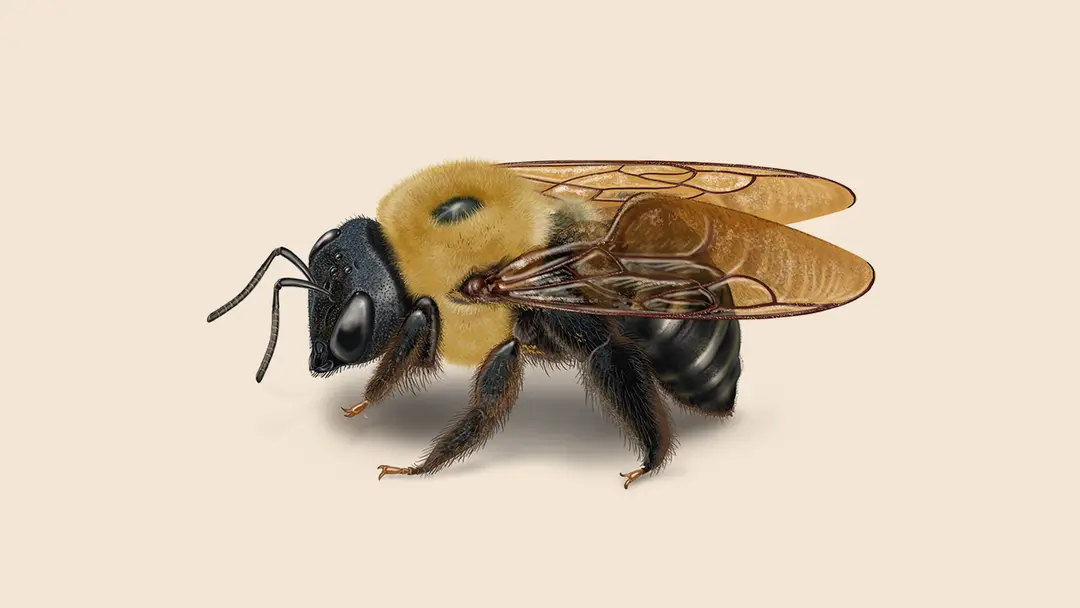
What do carpenter bees look like?
Within the United States carpenter bees are categorized in two genera – large carpenter bees (Xylocopa) and small carpenter bees (Ceratina). Xylocopa is the group of most likely to make their presence and associated damage known to property owners. The most obvious characteristic used to separate large and small bees is size.
Large Carpenter Bee (Xylocopa)
-
anywhere from 12-25 mm long
-
similar in size and appearance to bumble bees
-
black, greenish black, metallic blue, or purplish blue in color
-
yellow sections on the face (males)
-
yellowish hairs on the legs, thorax, and abdomen (not as as vibrant or as numerous as they are on bumble bees)
-
no visible hairs on the top of the abdomen
Small Carpenter Bee (Ceratina)
-
less than 8 mm long
-
dark in color
-
metallic appearance
-
scant body hairs
-
some kind of yellow markings on the body and face.
What do carpenter bees eat?
Carpenter bees do not eat wood but do feed on plant pollen and nectar.
Carpenter Bee Damage
Large carpenter bees excavate dry, unpainted and weathered wooden objects such as the following:
-
doors
-
windowsills
-
roof eaves
-
railings
-
decks
-
untreated poles
-
fences
-
wooden lawn furniture
Types of Wood Excavated
One of their favorite items to excavate is the rails and posts of oak split rail fences. They prefer pine, fir, cypress, oak and redwood, especially if the wood is not covered with bark, is unpainted or unfinished.
The bees sometimes bore into painted wood, especially if the paint covering is old and weathered.
Carpenter Bee Gallery
Gallery construction is a labor-intensive process that takes a lot of time and energy. As a result, females often prefer to inhabit existing nests instead of excavating new ones. Refurbished tunnels may increase several feet over several years. When required, females will use their strong mouthparts to chew round nest entrances in flat wood surfaces.
Gallery Entrance Holes
This hole is slightly less than 1/2-inch wide, which is about the diameter of her body and looks much like a carpenter used a 1/2-inch drill to create the opening. The bore hole goes into the wood perpendicular to the wood's grain for about 1-2 inches and then takes a right angle turn continuing as an excavated gallery (tunnel) that runs about 4-8 inches. The female then partitions off brood cells into linear rows. When finished, she places a food ball (made from pollen and regurgitated nectar) inside a brood cell, lays an egg, and blocks the chamber off with chewed wood pulp. After laying eggs, the female dies. The eggs hatch and become larvae that feed on the food ball until they pupate.
Small carpenter bees, or Ceratina, generally excavate twigs and stems to build their nests. Females overwinter as adults in partially or completely excavated stems, and in the spring, the female bee further excavates and creates a brood nest much the same as large bees. The small bees also provision their brood cells with pollen and nectar.
Carpenter Bee Lifecycle & Reproduction
Carpenter bees have four life stages: egg, larval, pupal, and adult states. It takes about seven weeks for a carpenter bee to reach adulthood, but developmental time may vary depending on temperate or other environmental conditions. Newly developed adults usually remain in their galleries for several weeks and leave their brood cells in April or May.
They mate, feed on pollen and nectar, return to their gallery to overwinter and then emerge the following spring. Large carpenter bees have one generation per year in the northern states, but in southern states like Florida, they may have two or more generations per year.
A particularly interesting characteristic of a few species of Ceratina is they can reproduce without males, a trait known as parthenogenicity.
Carpenter Bees vs. Bumble Bees
Carpenter bees and bumble bees may look similar, but they have key differences:
-
Nesting habits: Carpenter bees bore into wood to create nests, while bumble bees nest in the ground or in abandoned animal burrows.
-
Appearance: Carpenter bees have a shiny, hairless abdomen, while bumble bees are covered in dense, fuzzy hair.
-
Behavior: Carpenter bees are solitary insects, whereas bumble bees live in social colonies with a queen, workers, and drones.
Both are important pollinators but differ significantly in their nesting and social structures.
More Carpenter Bee Facts
Carpenter bees are important pollinators and are very useful in providing this beneficial service to agriculture, plant growers and fruit producers. However, they are also a nuisance and, given time, may cause structural damage resulting from their gallery and borehole excavations. Other nuisances or damage includes:
-
Deposition of their excrement/pollen under the entrance hole is unsightly.
-
Accumulations of sawdust from their borings and excavations
-
Woodpeckers may riddle the wood with holes searching for the immature stages of these bees to eat.
What Are Carpenter Bees?
Learn about carpenter bees & how to identify them against bumble bees.
More Resources on Carpenter Bees
I Have A Carpenter Bee Infestation
Learn how to identify and manage carpenter bee infestations, including signs of damage, prevention tips, and when to seek professional help.
How Do You Exterminate For Carpenter Bees?
Because carpenter bees are not easily controlled, costs and treatments may vary.
Explore common types of wood-boring insects, their signs of infestation, and strategies for preventing and controlling damage to wooden structures.