Honey Bee Facts & Information
Protect your home or business from honey bees by learning about these pollinators that help support both ecosystems and global agriculture. Contact a professional to relocate them safely.

Treatment
How to Relocate Honey Bees
Professional Honey Bee Pest Control
Honey bees play a critical role in our ecosystem as vital pollinators, and Orkin recognizes their importance. That's why, whenever possible, we aim to safely remove and relocate honey bees rather than harm them. In many areas, we partner with local beekeepers to ensure the bees are transferred to a more suitable location where they can continue to thrive. While we do everything we can to avoid killing honey bees, there are rare situations where they pose a serious safety risk and must be treated. Your local Orkin Pro is trained to help manage honey bees and similar pests. Since every building or home is different, your Orkin Pro will design a unique treatment program for your situation.
Orkin can provide the right solution to keep honey bees in their place...out of your home, or business.
Behavior, Diet & Habits
Understanding Honey Bees
Honey Bee Characteristics
Honey bees, although one of the most popular bees, represent only a small percent of bee species. Honey bees are the only surviving group of bees from the Apini tribe, which is under the Apis genus. They are known for producing and storing honey, or liquefied sugar, as well as building impressively large nests using wax secreted by workers in a particular colony.
The honey bee is one member of the insect class Insecta. These insects are members of the subfamily Apinae, which produce and store liquefied sugar, otherwise known as honey.

Honey Bee
What do honey bees look like?
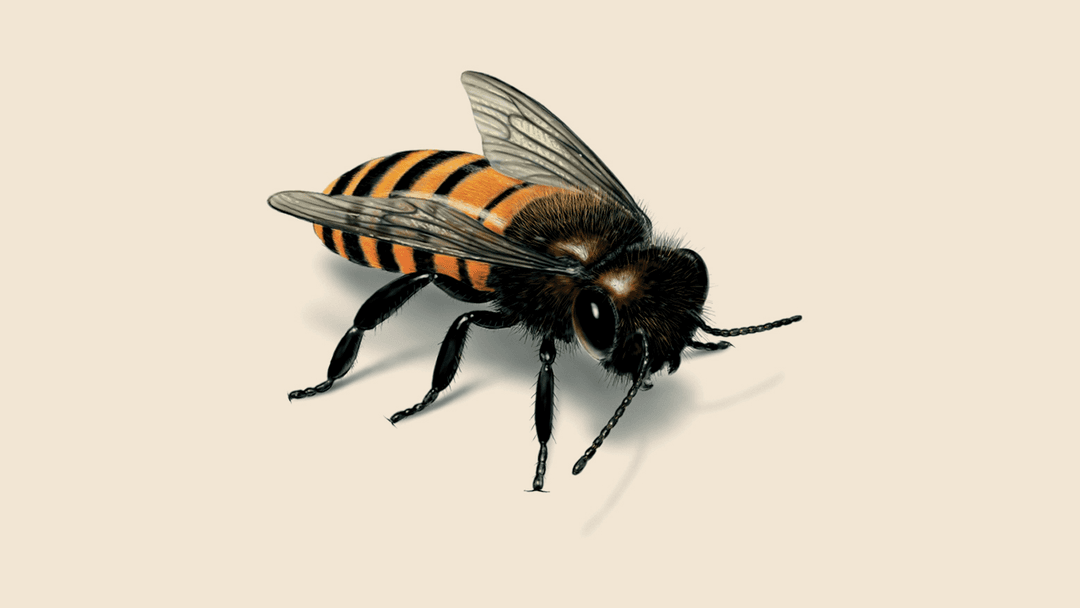
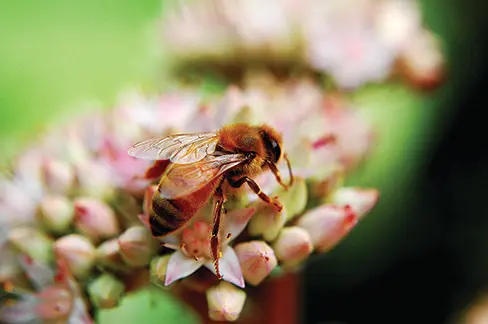
Honey bees measure about 1/2 inch long and are light brown in color. Honey bees are usually oval-shaped creatures with golden-yellow colors and brown bands. Although the body color of honey bees varies between species and some honey bees have predominantly black bodies, almost all honey bees have varying dark-to-light striations. These light and dark stripes serve a purpose for the survival of the honey bee: unlike other species that hide when they sense predators close by, the brightly colored bodies of the honey bee act as a warning to predators or honey robbers of the honey bees’ ability to sting.
Honey Bee Anatomy
The body of the honey bee is segmented: stinger, legs, antenna, three segments of thorax and six visible segments of abdomen.
The head of the honey bee consists of the eyes, antennae and feeding structures. The eyes include the compound eye and the simple eye: the compound eye helps bees understand color, light and directional information from the sun’s UV rays, while the function of the simple eye, also called ocelli, helps in determining the amount of light present. The antennas’ function is to smell and detect odors and to measure flight speed. The mandible is the bee’s jaw, which is used in eating pollen, cutting and shaping wax, feeding larvae and the queen, cleaning the hive, grooming and fighting.
The thorax of the bee consists of the wings, legs and the muscles that control their movement. The forewing, which is typically larger than the hind wing, is used for flight and as a cooling mechanism, while the latter is used to fan away heat and cool the hive.
Lastly, the abdomen’s six segments include female reproductive organs in the queen, male reproductive organs in the drone and the stinger in both workers and queen.
Honey Bee Behavior
In the wild, honey bee hives are often located in the holes of trees and on rock crevices. The hive is made from wax from the special abdominal glands of worker honey bees. Workers sweep up a few flakes of wax from their abdomens and chew these flakes until the wax becomes soft. Workers then mold the wax and use it in making cells to form the hive. Unlike other bee species, honey bees do not hibernate during cold periods. Instead, they remain inside the nests huddled closely together, sharing body heat and feeding on stored food supplies.
Honey bees are social creatures and live in colonies. However, they do display some aggressive behavior within colonies: drones are ejected from their nests during cold weather, and a queen will sometimes sting other queens during mating fights for dominance. Although honey bees serve a significant role in pollination and ecology, measures should be taken to ensure that hives do not exist in close proximity to your home, due to the possibility of getting stung. Always contact a pest control professional before attempting to address an infestation.
How long do honey bees live?
The lifespan of a honey bee varies depending on its role within the colony. Worker bees are sterile females and make up the majority of the hive, typically live for about 4 to 6 weeks during the active spring and summer months, as they wear themselves out with foraging and other tasks. However, those born in the fall, known as winter workers, can live for 4 to 6 months because they remain inside the hive and are less active. Drone bees, the males of the colony, generally live around 8 weeks and exist primarily to mate with a queen; they die shortly after mating or are expelled from the hive before winter if they haven’t mated. The queen bee, on the other hand, has the longest lifespan, living anywhere from 2 to 5 years. Her main role is to lay eggs, up to 2,000 per day during peak seasons, and she is cared for continuously by the worker bees. Environmental factors, disease, and stress can also influence a honey bees’ lifespan significantly.
Do honey bees sting?
Yes, honey bees can sting, but they usually do so only when they feel threatened or when their hive is in danger. Worker bees are the ones that sting. When a honey bee stings a person or animal with thick skin, its barbed stinger gets stuck, causing the bee to die shortly afterward. This makes stinging a last resort for honey bees. Queens also have stingers, but they rarely use them except when fighting rival queens. Drones, the male bees, do not have stingers at all.
Structure of a Honey Bee Colony
Like some other bee species, honey bees are social and live in colonies numbering in the thousands. Three castes of adult honey bees reside in one colony: the queen, male drones and infertile female workers.
In each colony, there is only one egg-laying queen, but there are thousands of workers. The queen honey bees mate with drones, establish new colonies and lay eggs. Queen bees lay eggs in the cells of the nest, and when they hatch, they become larvae. Each colony contains only one queen, who is capable of producing 2,000 eggs a day.
Adult workers tend the larvae inside the cells and feed them with pollen and honey for approximately three weeks, at which point they become a pupae before reaching adulthood. Mature bees chew themselves out of the sealed cells to emerge.
Drones, or male bees, are the minority in a colony and serve only one purpose: to mate with virgin honey bee queens. Soon after mating, drones die.
Although infertile worker females usually do not produce their own eggs nor establish new colonies, they perform several important tasks. Young honey bee workers tend to larvae by secreting liquid from their abdominal glands. As workers mature, they become responsible for carrying and storing food gathered by foragers. As strong adults, they forage for food until they die.
Where are honey bees located?
Honey bees species are found worldwide and can be seen in many different locations, including Europe and the United States. They are most visible in summer and late spring, when new queens leave their old colonies along with thousands of workers to build new nests. At this time, large groups of bees can be seen swarming together to find a new nesting place. It takes a swarm approximately 24 hours to locate a new nesting site. While most swarms are harmless, certain species of bees are extremely aggressive and may attack unprovoked.
Because honey bees are found worldwide, their nature and behavior can vary. For instance, while Italian honey bees are usually more docile, German and African honey bees can display extremely defensive behavior. However, all honey bees can become defensive when provoked and can chase humans or animals hundreds of feet.
Honey Bee Pollination
For millions of years honey bees have been major pollinators of flowers and, therefore, the plants producing the flowers have relied on the bees. The goal of the plant is reproduction. The bees help accomplish this by unwittingly transferring pollen, a plant’s male sperm cells, from one flower to another. Without pollination, many plants would not be able to procreate and eventually would die out.
How Honey Bees Make Honey
Honey bees make honey by collecting nectar from flowers and storing it in a special organ called the honey stomach. As the nectar is transported back to the hive, it's mixed with enzymes that break down complex sugars into simpler ones. Once back at the hive, the nectar is passed between worker bees, further reducing its moisture content, and then deposited into honeycomb cells. The bees then fan their wings to evaporate even more water, thickening the nectar into honey. When the consistency is just right, the bees seal the cell with wax, preserving the honey as a vital food source, especially for the winter months.
Do bees eat honey?
Yes, bees do eat honey. Honey is their main source of food, especially during times when nectar and pollen are scarce, such as in the winter or during bad weather. Worker bees produce honey by collecting nectar from flowers, then breaking it down with enzymes and storing it in honeycomb cells where it thickens over time. The stored honey provides energy for all members of the colony, including the queen, drones, and other workers. It’s essential for their survival, especially when they can't forage outside.
How Honey Bees Communicate
There are two major theories on how honey bee foragers communicate with other workers about a new food source: the honey bee dance and the odor plume. Although there is evidence to support each claim, the honey bee dance is more widely accepted. The dance language combines dancing and odor as a bee’s means of communication, while the odor plume theory claims that honey bee recruitment relies solely on floral odor. The honey bee dance plays an important role in the survival of the species: it has been a part of colonies for years and has remained one of the most important methods used in foraging for food.
The honey bee dance is a way for bees to communicate with one another. A honey bee that discovers a new food source will tell other honey bees about its location through the honey bee dance. When a worker bee returns from an abundant food source, she will dance inside their nest in a circle.
There are two main types of honey bee dances: round dance and waggle dance. Round dance, as the name indicates, is a movement in a circle. This is used to indicate the food source is less than 50 meters from the nest. Waggle dance is a figure eight pattern while the bee waggles its abdomen and is used for food located at a distance of more than 150 meters. Exact distance can be communicated by duration of the dance. A longer dance indicates a great distance.
The dancing worker bee also can indicate direction with the waggle dance and will move in reference to the sun’s vertical position. The degrees to the right or left of the vertical indicate the direction of the food. For example, if the bee’s dance is rotated 30 degrees to the vertical then the food will be found at a 30 degree angle from the nest related to the sun’s vertical.
This language is also understandable by humans, and researchers determine effectiveness by measuring the amount and quality of new pollen and nectar brought into the nest. However, certain features of this dance language, including the fact that honey bees understand dance patterns even in the dark, are still not understood.
Are honey bees endangered?
Honey bees are not officially classified as endangered as a species, but they do face significant threats that have raised serious concern among scientists, beekeepers, and environmentalists. Their populations have declined in some regions due to a combination of factors, including habitat loss, parasites like the Varroa mite, climate change, diseases and pesticides. While managed honey bee colonies (those kept by beekeepers) are generally maintained through human care, wild and feral honey bee populations are more vulnerable.
It's also important to note that while honey bees get a lot of attention, many native bee species (like bumblebees and solitary bees) are at greater risk and some are officially listed as endangered. Overall, the decline in bee populations as a whole poses a serious threat to biodiversity and food production, since bees play a crucial role in pollinating many of the crops we rely on.
Honey Bee Control
As pollinators, honey bees are critical to the environment and the food supply. Unfortunately, they also can become a medical and structural threat if they nest near people and buildings. Bees and other pollinators are protected in many states, so if an infestation should occur in or near a dwelling, consumers should consider contacting a local beekeeper to relocate the nest. A beekeeper can assess the situation and determine if it is feasible to remove the nest. This can be an intensive process, especially if the nest is large. For more information on honey bee nest relocation, contact a local bee keeper or an apiary society .