Facts and Information about Springtail Bugs
Protect your home or business from springtails by learning techniques for identification and control.

Treatment
How do I get rid of springtails?
How does Orkin get rid of springtails?
If you suspect you have a springtail infestation, contact an Orkin Pro and ask for an inspection and pest identification. If your exterminator determines the culprits are springtails, he or she will prepare an integrated pest control treatment program designed to provide educational information plus effective nonchemical and chemical control measures.
As mentioned above, springtails usually are not a major exterior problem. However, when their exterior habitat begins to dry, these insects will often move inside. Therefore, your springtail treatment plan will likely focus on what is needed for both exterior and interior springtail treatment.
Exterior treatment for springtails if needed may include:
Locating where persistent, excessive moisture occurs and taking actions to reduce the amount of moisture there. For example, your Orkin Pro might recommend fixing any moisture leaks or areas of excessive water runoff from downspouts, reducing the thickness of moisture holding mulch or leaf litter and removing any wet wood or other debris. In some situations, using a labeled chemical product in areas where springtails are especially numerous and around the locations they use to enter the building may be required.
Interior treatment for springtails when needed may include:
Locating, drying out and treating places with excessive moisture, especially if the moist condition harbors mold or mildew growth. Such locations may include dampness around tubs and sinks or inside damp wall voids. In addition, using vacuums to remove adult springtails that are either alive or dead is helpful.
Frequently Asked Questions
Behavior, Diet & Habits
Understanding Springtails
What do springtails look like?
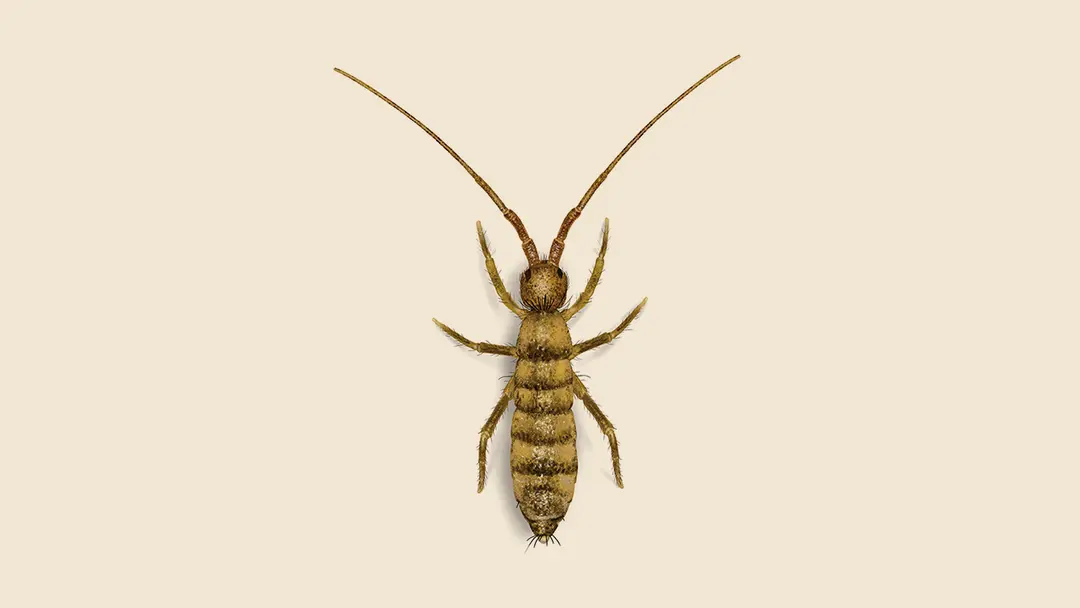
Springtails are very small insects, typically ranging from 0.25 to 6 mm in length. Their bodies are soft and may appear slender or oval-shaped depending on the species. One of their most distinctive features is a forked, spring-like structure called the furcula, located on the underside of the abdomen. This allows them to jump quickly when disturbed, which is how they got their name. One jump can cover 10 centimeters.
Where do springtails live?
Springtails typically live in damp environments, especially in the layer between soil and decaying plant material. Outdoors, they’re commonly found in flowerbeds, under mulch, logs, paving stones, landscape timbers, and woodpiles. Because they lose moisture through their skin, they rely on high-humidity conditions to survive. When their environment dries out, they often migrate in search of more moisture, sometimes ending up indoors in places like basements, bathrooms, or around leaky plumbing. Read more about their habitat.
What do springtails eat?
Springtails primarily feed on mold, fungi, algae, and decaying plant material, which is why they’re commonly found in damp, organic-rich environments. Their diet helps recycle nutrients in soil, but it also draws them to moist areas indoors where mold or mildew may be present.
Do springtails bite?
Springtails do not bite or sting people. They do not damage buildings or the contents. They develop quickly. It is common to find springtails in very large numbers. The fact that there can be thousands of jumping insects in an area can be very distressing to homeowners.
Springtail Reproduction
Male springtails deposit a sperm-containing structure, called a spermatophore, on the ground. Females then pick it up to fertilize themselves. Eggs are laid either individually or in clusters, typically in moist environments. The time it takes for springtails to develop from egg to adult varies by species and environmental conditions.
More Information
Springtails are tiny insects that thrive in moist environments, both outdoors and indoors. They are commonly found in soil, mulch, and leaf litter, as well as in damp areas of homes like bathrooms, kitchens, basements, and crawlspaces.
They don’t bite or sting and are considered harmless to humans. When found indoors, they’re typically just a nuisance and may be mistaken for fleas due to their jumping behavior.
Springtails can infest homes by entering through small openings, especially when outdoor conditions become too dry. They are attracted to moist indoor areas like kitchens, bathrooms, and basements, often congregating near leaky pipes or damp materials.
Springtails are harmless and thrive in damp areas, while fleas are parasitic, bite humans and pets, and can spread disease. Although both jump, only fleas pose a health risk.