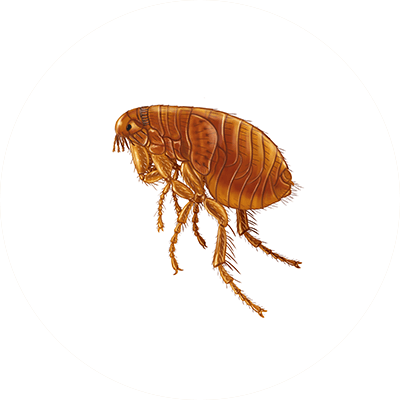
What is the Life Cycle of a Flea?
Flea Life Cycle Stages
A flea's life cycle consists of four stages: Egg, Larvae, Pupa, Adult
Flea Life Cycle Stage 1: Egg
How many eggs does a flea lay?
Fleas lay between four to eight eggs after a meal, with the highest concentrations of laying occurring within the last few days of the female's life. A female flea can lay over a hundred eggs during its lifetime depending on environmental conditions.
How often do fleas lay eggs?
Female fleas begin laying eggs within 48 hours of the first feed, thus beginning the life cycle again.
Can flea eggs hatch without a host?
Unlike the eggs of some other parasites, flea eggs are not sticky and usually fall to the ground immediately upon being laid on a host. Flea eggs can hatch without a host and develop into a larvae depending on the environmental conditions.
How long does it take for flea eggs to hatch?
Flea eggs hatch into larvae within 1 to 12 days. Cold environments cause eggs to perish before hatching.
Flea Life Cycle Stage 2: Larvae
Where do flea larvae come from?
Flea larvae hatch from eggs that were laid by a female flea and have fallen off the animal host.
What does flea larva look like?
Flea larvae complete three larval instars (stages) and, depending on their environment, will range in length from about 3-5 mm long. Flea larvae have no eyes and no legs. Their body is maggot-like and whitish, but turns progressively darker as the larvae feeds on feces excreted by the adult fleas.
How long do fleas stay a larvae?
The larval stage lasts from 4 to 18 days, after which larvae spin silk cocoons and enter the pupal stage. Humidity below 45 percent will kill larvae.
What do flea larva eat?
Other than feces, larvae will feed on various types of organic matter such as food particles, dead skin, dead insects and feathers.
Do flea larva need blood?
Flea larvae do not take a blood meal directly from a host, unlike adult fleas.
Where do flea larvae live?
Once away from the host, the larvae seek out shaded locations such as cracks in the floor, in carpets, in pet bedding or protected locations under and in furniture. Flea larval survival depends on relative humidity and temperatures. Since dehydration is fatal to flea larvae, they will not survive relative humidity less than 45-50 percent or soil temperatures greater than 95 degrees Fahrenheit. However, if outdoors, larvae will survive in cool, shaded areas and do very well in crawl spaces. In environments of suitable humidity and temperatures, fleas will develop year-round.
How do you get rid of flea larvae?
Controlling flea larvae usually involves using vacuums to remove, use of insect growth regulators and dust formulations that cause desiccation of the larvae.
Flea Life Cycle Stage 3: Pupa
What does flea pupae look like?
A flea larvae will spin a cocoon around themselves like a caterpillar, creating a protective casing. Once the flea is fully protected within its cocoon, the flea undergoes metamorphosis, and then will transform into an adult.
How long can flea pupae live?
The pupal stage can last from a few days to several months. The lifespan of a flea pupae will depend on environmental factors such as temperature and humidity. Fleas in the pupal stage will become adults more rapidly in the presence of warmth and high humidity. Once a flea is in the pupal stage they can be more resistant to many environmental conditions and insecticides.
How long can flea pupae lay dormant?
The flea pupal stage may last three days, or it can last as long as one year.
Flea Life Cycle Stage 4: Adults
What do fleas eat?
Adult fleas begin searching for food when they emerge from the pupal stage. They typically feed on the blood of their host.
Do fleas jump?
While fleas are noted for their jumping abilities and may look like they can fly, they will remain stationary when a suitable host is located.
How do fleas reproduce?
Typically, in adult fleas, male flea locates a female flea to reproduce.
How fast do fleas reproduce?
With a host for blood meals and the right environmental conditions a flea can continuously reproduce creating hundreds or thousands of fleas in a short span of time.
How long do fleas live?
The lifespan of a flea is dependent on whether it can find a host for blood meals and environmental factors such as temperature and humidity. An adult flea in the right conditions and food supply can live up to 100 days or 2 to 3 months. Without a host or proper conditions, a flea will live up to a few days or just 1 to 3 weeks.
Schedule Flea Pest Control
In need of flea pest control? Contact an Orkin Pro near you to schedule a free pest control inspection.
More Flea Facts