House Flies
Protect your home or business from house flies by learning techniques for identification and control.
House Fly Treatment
How do I get rid of house flies?
To keep house flies away, you need to be diligent. Sanitation and exclusion are your best weapons.
-
Seal the Perimeter: Inspect your screens for rips and check weather stripping around doors. Flies can squeeze through tiny cracks.
-
Manage the Trash: Keep garbage cans clean and tightly covered. Open trash is essentially an "All You Can Eat" buffet for flies.
-
Clean Up Pet Waste: Dog feces is a prime breeding ground. Scoop the yard daily to remove temptation.
-
Eliminate Moisture: Flies need moisture to breed. Fix leaky pipes and ensure drains are clean and flowing freely.
-
Store Food Properly: Don't leave fruit or leftovers sitting out uncovered on the counter.
What Orkin Does to Get Rid of House Flies
House flies can be a real nuisance when they are flying around. But they can also transmit diseases, so it is important to get rid of them. House fly control is not always as easy as it sounds. There is often more involved than a fly swatter. House fly control involves several steps, and Orkin can help.
The first step is identification. It is easy to confuse house flies with several other fly species, including cluster flies. The different types of flies may look similar, but they require different control methods. Your Orkin Pro can help with the identification.
It is very important to identify the places where the flies have been depositing their eggs. It may be something simple like an uncovered trash can or a bowl of pet food on the patio. However, the house fly breeding site could be something that is not obvious. The breeding site must be cleaned up or removed. If the breeding site is not removed, the flies will continue to be a problem.
Orkin Pros are trained to spot these breeding sites during the inspection. They will also point out any structural issues, like torn screens or damaged weather stripping that the flies could use to get inside your home.
The next step is to eliminate the adult flies. Depending on the situation, it may be necessary to use fly bait, traps or an insecticide application. Your Orkin Pro will have all of these tools available. He or she is trained to make the application correctly.
Most homeowners find that it saves time and energy to call the local Orkin branch office to schedule an inspection for house fly control.
Frequently Asked Questions
Behavior, Diet & Habits
Understanding House Flies
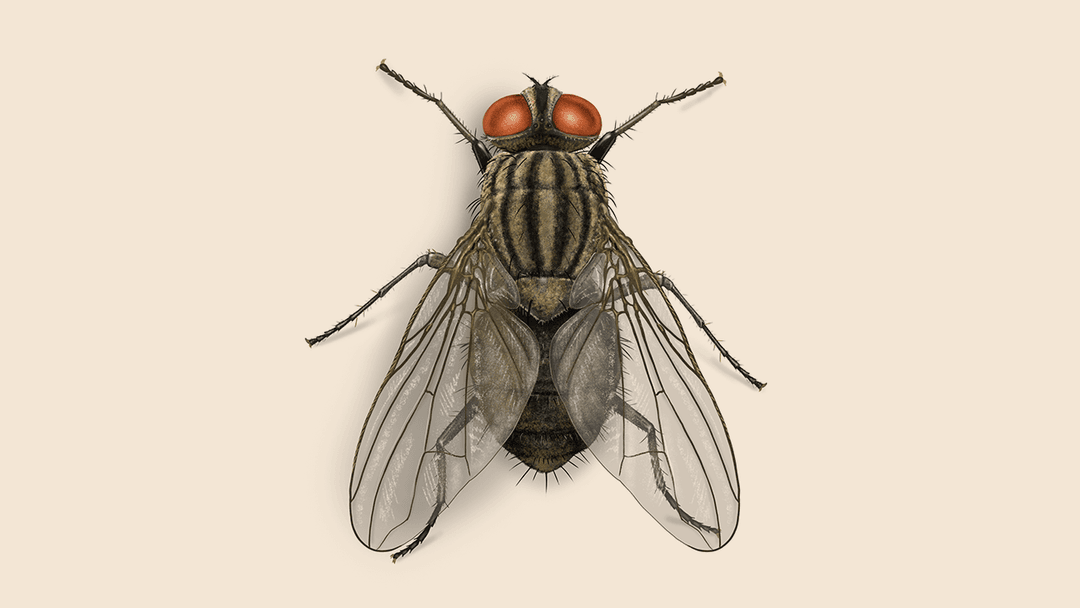
What do house flies look like?
Before you roll up a newspaper, make sure you know what you're swinging at. House flies are often confused with cluster flies or flesh flies, but they have a few specific tells.
-
Size: 4 to 7.5 mm long
-
Color: Usually gray
-
Body: Four black stripes on the thorax. House flies are covered with small hairs that serve as taste organs.
-
Eyes: Their compound eyes are extremely complex: thousands of individual lenses allow them a wide field of vision.
Where do house flies live?
They prefer corners and edges or thin objects to rest on. Indoors, they rest on floors, walls and ceilings during the day. Outdoors, they will rest on plants, the ground, fence wires, garbage cans, etc. Night resting places are usually near sources of food and 5 to 15 feet off the ground.
What do house flies eat?
A house fly’s diet includes a wide variety of food, including human food, animal food and carcasses, garbage and excrement. House flies don't have teeth. They have sponging mouthparts designed for a liquid diet. To eat solid food, they regurgitate saliva onto it to liquefy it, then sponge it up.
How do house flies reproduce?
House fly eggs are laid in almost any warm, moist material that will supply suitable food for the larvae. The female may lay a total of five to six batches of 75 to 100 eggs. In warm weather, eggs hatch in 12 to 24 hours. Read more about the house fly life cycle or gestation of a house fly.
How long do house flies live?
The average life span for a house fly in the wild is less than one month. Read more.
Diseases Transmitted by House Flies
House flies are major carriers of disease. They are known to transfer over 100 pathogens resulting in ailments, including typhoid, tuberculosis, cholera and dysentery.
More Information
House flies have compound eyes with thousands of lenses, giving them nearly 360° vision and rapid motion detection.
House flies produce a low buzzing sound by rapidly beating their wings, a noise often associated with their presence indoors.
House flies spread bacteria and pathogens by landing on food and surfaces, making them a health risk in homes and businesses.
House flies can transmit serious diseases like salmonella, cholera, and dysentery by contaminating food and surfaces with pathogens.
Several house fly species exist worldwide, each varying in size, color, and habits, but all share similar traits that make them common pests.
Lesser house flies are smaller than common house flies and often hover in midair, making them a frequent nuisance in homes and businesses.
Red house flies are a reddish-brown species often found indoors, known for their persistent buzzing and attraction to decaying matter.
Blue house flies, also called blow flies, are metallic blue pests attracted to decaying organic matter and often found near garbage or carcasses.