How to Help Prepare Healthcare Pest Control Programs for The Joint Commission Surveys

Key Takeaways
-
Pest control is evaluated under The Joint Commission Environment of Care standards, not as a standalone requirement.
-
Surveyors expect an Integrated Pest Management (IPM) program that helps support patient safety and minimize risk.
-
Compliance depends on clear documentation, response protocols and defined accountability, not just having a vendor in place.
-
Gaps in pest management can impact hazardous materials compliance, Environment of Care standards and ultimately your accreditation outcome.
Survey-ready pest control means having a documented, compliant program your team can validate in real time during The Joint Commission survey. It helps ensure staff can quickly access records, explain processes and demonstrate how pest risks are managed to help support patient safety.
Why Pest Control Matters in The Joint Commission Surveys
Pest control appears in The Joint Commission tracers because it directly impacts patient safety, hazardous materials management and infection management.
Surveyors aren’t just checking a box. They want to see how your pest control program works in real time and whether your team can prove it.
Where Pest Control Falls in The Joint Commission Standards
Pest control falls under The Joint Commission’s Environment of Care standards, where it plays a key role in safety and risk management. There’s no single “pest control” checklist, but surveyors will look closely at how your Integrated Pest Management (IPM) program helps support compliance, documentation and patient safety.
Common Pest Control Questions During Inspections
During tracers, questions can sound like:
-
“What happens when staff report rodents?”
-
“Can you show where your pest control documentation and safety data sheets are stored?”
-
“How does your pest control program minimize chemical use while maintaining patient safety?”
If your answers are slow, inconsistent or vary by person, your program isn’t truly survey-ready, even if you have a contract in place.
The Four Pillars of “Survey-Ready” Pest Control
Survey-ready pest control isn’t complicated, but it does require consistency. These four pillars are what surveyors expect to see in place.
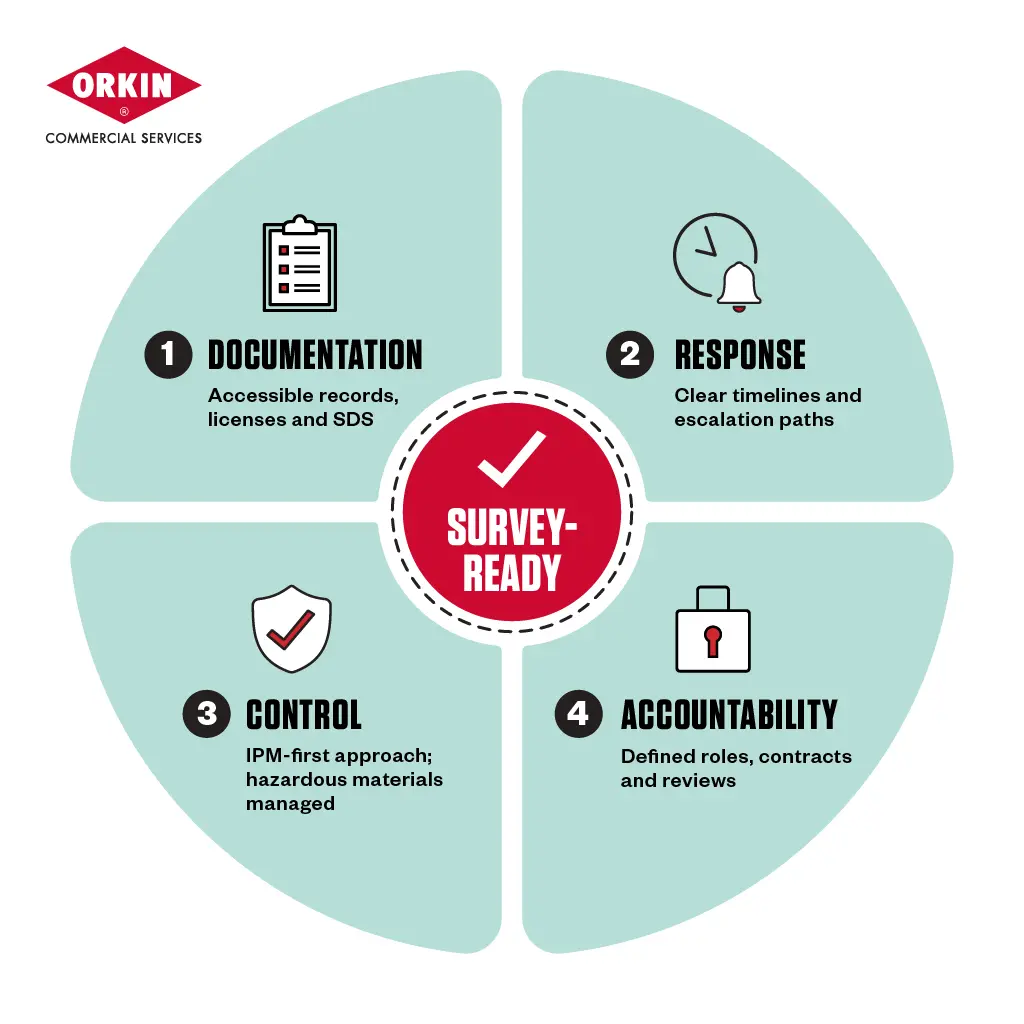
1. Documentation You Can Grab Quickly
Surveyors expect fast, clear proof that your pest control program is documented, compliant and aligned with hazardous materials standards.
This goes beyond a service log; it means having a system your staff can access quickly, often supported by digital pest monitoring tools that centralize documentation.
Make sure you can quickly access:
-
Pesticide applicator licenses (on file or referenced in your pest management contract)
-
Safety Data Sheets (SDS) for all pesticides used on-site, accessible to staff
-
A current hazardous materials inventory that includes pesticides
-
Staff training records related to disinfectant and pesticide use
-
Integrated Pest Management (IPM)
program documentation (pest monitoring logs, treatment records)
-
Exposure monitoring records showing no restricted pesticides are being used where they shouldn’t be
If only a few people know where these items live, or it takes too long to pull them, that’s a gap to close before your next survey.
2. Response Timelines
Survey-ready healthcare pest control also means your team can clearly explain what happens when someone spots a pest, or an electronic device triggers an alert. Surveyors are listening for a response process that minimizes risk from the moment activity is reported.
Your team should be able to walk through:
-
How to notify staff when they see pests or evidence of pests
-
How they report (phone, app, ticketing system, work order) and when (immediately, end of shift, etc.)
-
How issues are escalated when rodents, bed bugs or other high-risk pests (like mosquitoes) are involved
-
How quickly your pest control provider is expected to respond to urgent issues (for example, within 24-48 hours)
-
How you verify resolution after treatment (re-inspections, staff or patient confirmation)
You can have written procedures, but if staff members across shifts can’t describe them consistently, surveyors may see gaps in how your business protects patients and employees.
3. Control of High-Risk Pests and Hazardous Materials
From a survey perspective, pest control is also hazardous for materials management. The Joint Commission surveyors look for proof that your Integrated Pest Management (IPM) program helps reduce chemical risk while still protecting vulnerable patients.
Your pest program should show:
-
Pests properly identified, activity monitored and structural or sanitation issues addressed before chemical treatment
-
Treatments used as a last resort, with non-chemical methods whenever possible
-
Targeted treatment methods to help minimize environmental impact
-
Staff trained on preventive actions that help reduce pest pressure in high-risk areas, like patient rooms, pharmacies and kitchens
On the hazardous materials side, they’ll also expect:
-
Restricted pesticides applied only by licensed applicators
-
Pesticide containers triple-rinsed with all rinse water collected and managed as hazardous waste
-
Waste pesticides documented and disposed of as hazardous waste
For many facilities, hitchhiking pests like bed bugs are a top concern because they can arrive with patients, visitors or staff and spread quickly if not handled with a well-documented and targeted protocol. Being survey-ready means you can show both your clinical leadership and surveyors exactly how you contain and treat these issues without compromising patient safety.
4. Clear Accountability
Finally, a surveyor wants to know who owns pest control decisions across your facility. When answers point to “a few different people” or “it depends,” that can look like unclear responsibility and potentially conflict with Environment of Care expectations.
To demonstrate accountability, you should have:
-
A single point of contact for pest control program oversight and surveyor questions
-
A pest management contract that spells out provider response times and scope of services
-
A scheduled, documented annual review of your pest management program
-
Assigned monitoring responsibilities for high-risk areas like the kitchen, pharmacy and patient care units
When roles, documentation and response protocols aren’t clearly defined, small gaps can turn into survey findings.
Start with our Pest Control Checklist: Preparing for The Joint Commission Survey to quickly identify gaps and take action before your next survey.
How Orkin Helps You Get (and Stay) Survey-Ready
Your team has enough to manage. Staying compliant with The Joint Commission pest control standards shouldn’t make your job harder.
With more than 125 years of experience, Orkin understands healthcare compliance and what surveyors expect to see from your pest control program — from the documentation and on-site practices to how your staff responds in real time.
When you partner with Orkin, you can:
-
Benchmark your current pest management program against The Joint Commission expectations.
-
Tighten reporting and escalation protocols around rodents, bed bugs and other high-risk pests.
-
Help reduce reliance on treatments by strengthening Integrated Pest Management (IPM) practices and preventive measures.
-
Clarify roles, responsibilities and contract expectations, so staff feel prepared when surveyors ask questions.
-
Help train staff to prepare for surveys with mock questions, so responses are consistent and confident during the real thing.
Help train staff to prepare for surveys with mock questions, so responses are consistent and confident during the real thing.
Not sure if your pest control program will hold up during a survey?
Schedule a healthcare compliance review with an Orkin Pro to get absolute confidence in your pest control.

FAQs: Healthcare Pest Control & Survey Readiness
What does “survey-ready” pest control mean in healthcare facilities?
Survey-ready healthcare pest control means having a documented, compliant program that can be validated during The Joint Commission survey. Staff should be able to quickly access records, explain procedures and demonstrate how pest risks are managed. It ensures your facility is always prepared for inspection, not scrambling to catch up.
What is Integrated Pest Management (IPM) in healthcare settings?
Integrated Pest Management (IPM) is a proactive approach that focuses on prevention, monitoring and targeted treatments. In healthcare facilities, IPM helps reduce reliance on treatments by addressing sanitation and structural conditions that attract pests. This approach supports both compliance and patient safety goals.
What do The Joint Commission surveyors look for in pest control programs?
Surveyors look for clear documentation, consistent staff responses and evidence of an Integrated Pest Management (IPM) approach. They may ask for service records, Safety Data Sheets and response procedures for pest sightings. Just as important, they expect staff across departments to give consistent answers.
Healthcare Pest Control Resources
Healthcare Pest Control
6 Healthcare Settings That Attract Pests
5 Most Common Pests in Healthcare Facilities
10 FAQs About Bed Bugs in Healthcare Facilities
What Patients Do Not Want to See in Healthcare Facilities